
Switching HR or payroll systems? Keep every record. Move only what you need.
Paystoric extracts your complete payroll, time, HR and recruiting history — every record, every document, every year — and keeps it searchable, reportable and audit-ready for as long as you need it. Nothing to sort through or sign off on. Need some of it in your new system? We move that too.
Tell us what system you're leaving. We'll take it from there.
- Payroll
- Time
- Employees
- Tax
- HR docs
- Recruiting
Pay stubs · Q3 2023
- Matches
- 79
- Pay dates
- 13
- Source
- Original
Fast. Easy. Priced right.
Your team is busy going live on the new system. Preserving the old one shouldn't be another project.
- Fast
18,000 documents an hour.
We extract while your old system is still live, so your archive is complete before access ends.
- Easy
Your only job is granting access.
No inventory of the old system, no deciding what to keep. We extract everything, verify it against your registers, and lock it down.
- Priced right
Priced on headcount, not on what you keep.
One price based on your active employees. Every module, every year, every document included. Starting at $150/month.
Keep everything. Don't pick and choose.
Every other way of handling history starts with a question nobody wants to own: what's safe to lose? Paystoric doesn't ask. Your new vendor takes a roster and year-to-date balances. We take everything else, as it was.
Not a curated subset. Everything your old system held:
Payroll
Registers, earnings, deductions, garnishments, pay stubs, multi-EIN history. Searchable by employee, period or pay type.
Time & attendance
Hour totals, overtime, leave, and raw clock-in/clock-out punches with audit trails.
Employees & HR
Job and compensation history, status changes, benefits, demographics, across the whole employment lifecycle.
Tax documents
W-2s, W-2Cs, 1099s, 1095-Cs, quarterly filings. Stored as originals, not re-creations.
HR documents
Offer letters, reviews, signed acknowledgements, I-9s, onboarding forms, benefits elections, linked to the employee record.
Recruiting & applicant data
NewCandidate profiles, applications, resumes and hiring records from your ATS (Greenhouse, Bullhorn, Breezy and more), kept for the retention window the law requires.
Anything else
Excel, CSV, PDF and images, digitized for search and reporting.
- Every record. Every document. Every system you're leaving.
See a finished archive in two minutes.
Employee look-up, a pay-stub retrieval from three years ago, and a time-detail report an auditor would ask for. No slides.
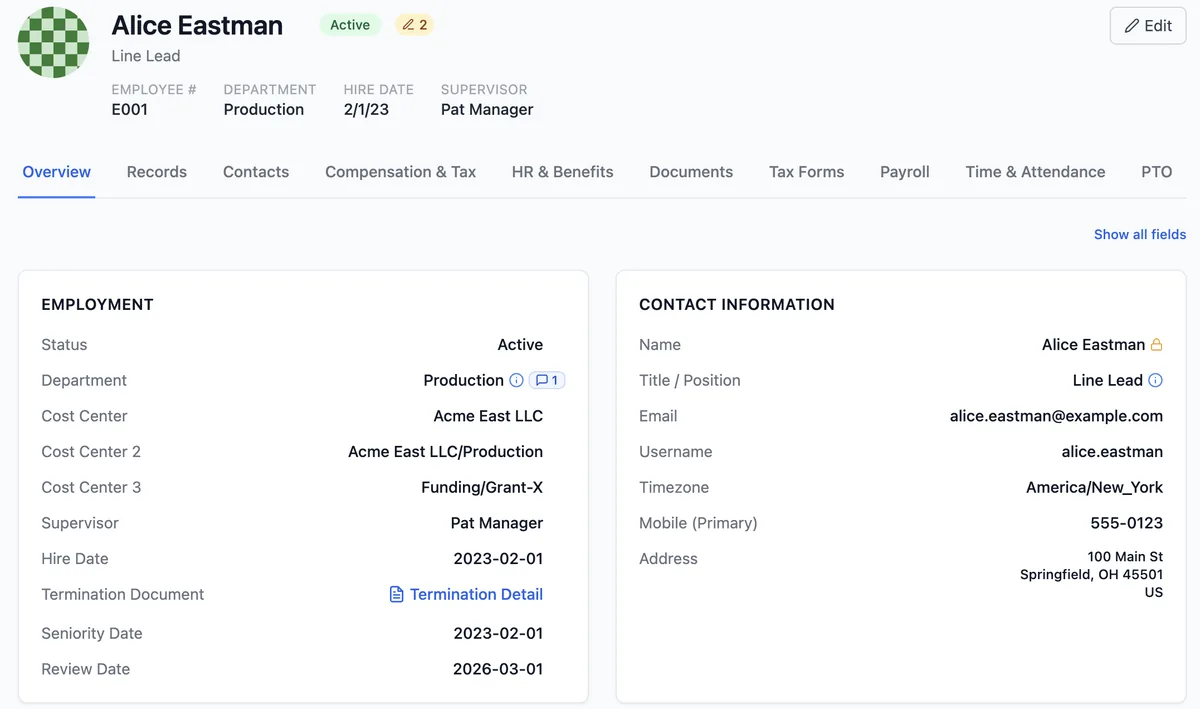
Employee overview (sample employee) 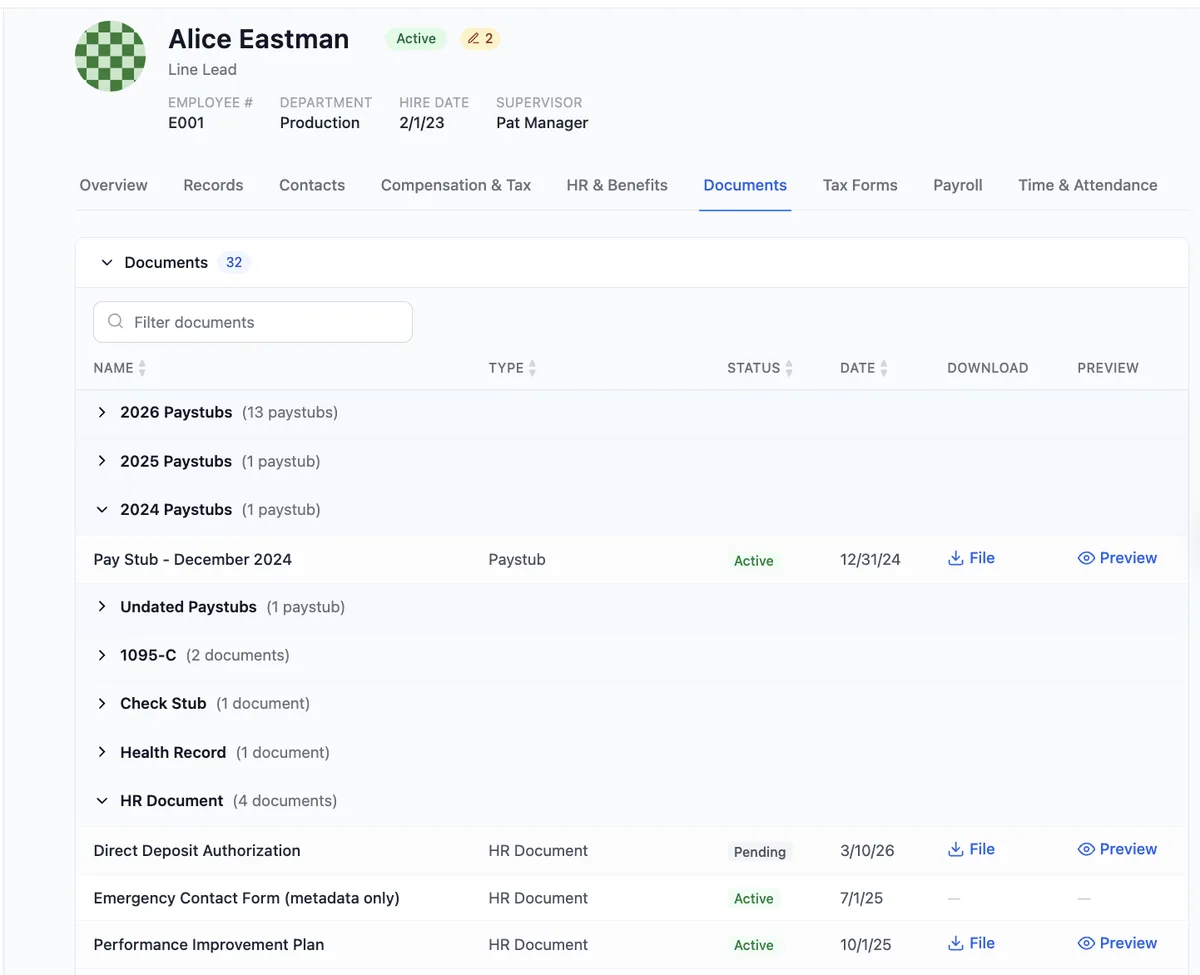
Documents tab with sections expanded 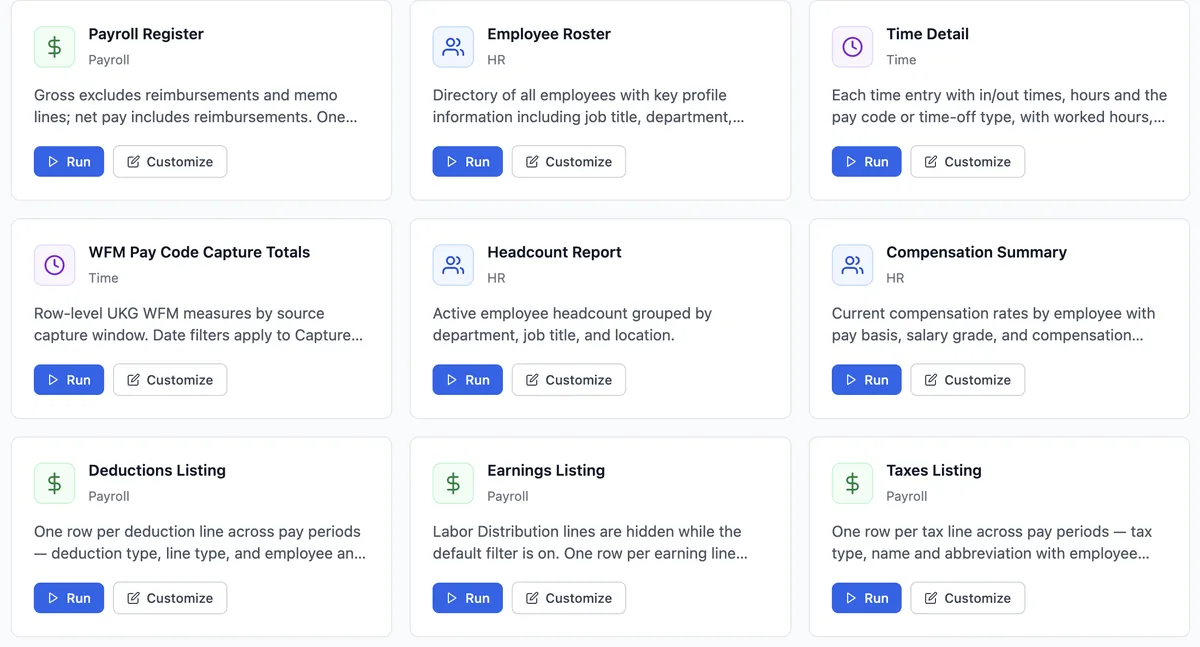
Reports main page
Priced on headcount, not on what you keep.
Most ways of keeping history charge by the module, the year or the gigabyte — which is exactly why someone ends up deciding what to cut. Paystoric is priced on your active employees. Payroll, time, HR, documents, applicants, all your years: included.
Starting at $150/month
Based on your active employees. Your full history is included. We'll quote your archive in the demo.
Book a 30-minute demoOne number to know.
Your active headcount. Not record counts, not document counts, not years.
No module math.
Payroll-only wouldn't change your price. So keep everything.
About 5–7% of your live system.
For history that outlives the vendor contract.
Your employee documents, moved to your new system.
Tax forms, original pay stubs, handbook acknowledgements and HR documents, transferred into your new HR/payroll platform and indexed to each employee. Originals, not re-creations.
Because the archive already holds everything, choosing what to move is the easy kind of decision: pick the documents employees and managers frequently access, so they can self-serve. Everything else, and a copy of what moved, stays in Paystoric. Your new system starts clean. Your records stay complete.
Employees stop asking HR.
Old W-2s and pay stubs are in the system they already log into.
Managers can verify.
Signed policies and certifications sit on the employee profile.
Priced per employee, not per document.
No counting, no surprise invoice when the total comes in.
Four ways companies handle history. One works.
…migrate it into the new system?
You rebuild retired benefit plans, old job codes and closed locations just to house records you'll rarely touch. You bring the mess of your old system with you, and punch-level time data and original stubs rarely make the trip.
…trim it down to the essentials?
Essential according to whom? The auditor in 2029 won't tell you in advance. Someone has to decide what's safe to lose, get sign-off, and own it if they guessed wrong.
…export everything to a shared drive?
Then an auditor asks for every pay stub for one employee across four years and someone spends a week in spreadsheets. No role-based access, no audit log, no reporting.
…keep a read-only license?
It buys a year, at a meaningful share of what you were paying. Then it ends. Your retention obligations don't.
Paystoric keeps the complete history out of your new system and still at hand.
Nothing chosen, nothing lost.
- Verified
- Locked
- Logged
- Searchable
Your retention obligation outlives your vendor contract.
Federal and state law requires you to keep payroll, time and employee records for three to seven years, longer for ERISA and OSHA. Your old vendor isn't liable for them after you leave. Your new vendor won't take them all. If you can't produce a record in a wage dispute, the burden of proof shifts to you (Anderson v. Mt. Clemens Pottery, U.S. Supreme Court).
48%
of small and mid-market companies hit a costly compliance issue in the last two years
$34K
average direct cost per incident
21 days
to produce payroll records in California, or $750 per violation (Labor Code §226)
Source: “The Criticality of HR Compliance,” Insperity/NelsonHall, Nov 2025.
Switching systems? Start here.
- Guide
HR & payroll record retention requirements (opens in a new tab)
Federal and state, with citations.
- Checklist
What to export before your old system goes dark (opens in a new tab)
The vendor-exit data checklist — or skip the list and keep it all.
- Guide
California employee record retention guide (opens in a new tab)
§226, §1198.5, PAGA exposure, and what to keep.
- Webinar, Nov 10
Going live on a new HR/payroll system (opens in a new tab)
How to keep your data compliant.
HCM vendors, resellers and implementation partners
“What happens to our history?” stalls deals and clogs implementations. Give your customer a one-line answer: all of it is kept, only transfer what absolutely needs to go into the new system. Paystoric takes the history off your project plan and delivers an employee-indexed document set for go-live. Referral and reseller programs available.
Frequently asked questions
Something else? hello@paystoric.com
Extraction runs while your old system is still live. Typical time from signed order to searchable archive is six weeks.
UKG Pro, UKG Ready, ADP Workforce Now, Paylocity, Paycor, Paychex Flex, iSolved, Rippling, Paycom, BambooHR, Greenhouse, Bullhorn, Breezy, Lattice and more, plus files in Excel, CSV, PDF or image formats from anything else. Don't see your system? No worries. We've built our extraction technology to quickly adapt to new systems, and it doesn't cost you anything extra.
No. We extract everything in the system you're leaving — every module, every year, every document — and the price is based on your active employees, not on what's in the archive. So there's nothing to pick and choose.
Plans start at $150/month, priced on your active employees. All modules, all years and all documents are included; there's no per-module or per-year charge. We'll quote your archive in the demo.
Yes. Document Transfer moves the documents you choose (tax forms, pay stubs, signed HR documents) into your new HCM, indexed to each employee, while the full record stays in Paystoric. It's an add-on to the archive; we'll quote it alongside.
Your data is verified, then locked. Every access is logged and role-based permissions control who sees what.
You receive a complete export of your data and documents in standard formats.
Tell us what system you're leaving. We'll show you how we keep all of it.
30 minutes. We'll walk through:
- What's in your current system
- What you can do with your data in Paystoric
- What it would cost
hello@paystoric.com · We reply within one business day.